


The most common bottleneck enterprise brands face when scaling paid ad budgets is diminishing returns: as monthly ad spend increases from $10k to $100k+, Customer Acquisition Cost (CAC) inevitably spikes while Return on Ad Spend (ROAS) compresses sharply.
This marginal decay happens because traditional ad setups rely on broad audience targeting and static retargeting pools that quickly saturate. Scaling media budgets profitably requires replacing guesswork with predictive audience modeling, algorithmic bidding strategies, and dynamic creative rotation across Meta and Google Ads ecosystems.
"Unscaled ad spend relies on broader reaching budgets; engineered ad scaling relies on predictive audience vectors that protect profit margins."
Linear Ad Budget Scaling vs. Predictive Vector Scaling
The table below contrasts traditional ad scaling methods against Global VA's algorithmic paid acquisition framework:
| Performance Metric | Linear Budget Scaling | Predictive Vector Scaling |
|---|---|---|
| Audience Expansion | Manual interest & demography doubling | Algorithmic Lookalikes & First-Party LTV Signals |
| CAC Management | CAC increases as audience saturates | CAC remains stable through dynamic bid capping |
| Creative Strategy | Static ad copy run until fatigue sets in | Modular creative variations refreshed systematically |
| Attribution Layer | Last-click platform reporting | Server-side CAPI & Multi-touch attribution modeling |
Pillar 1: Predictive Audience Vectors across Meta & Google Ads
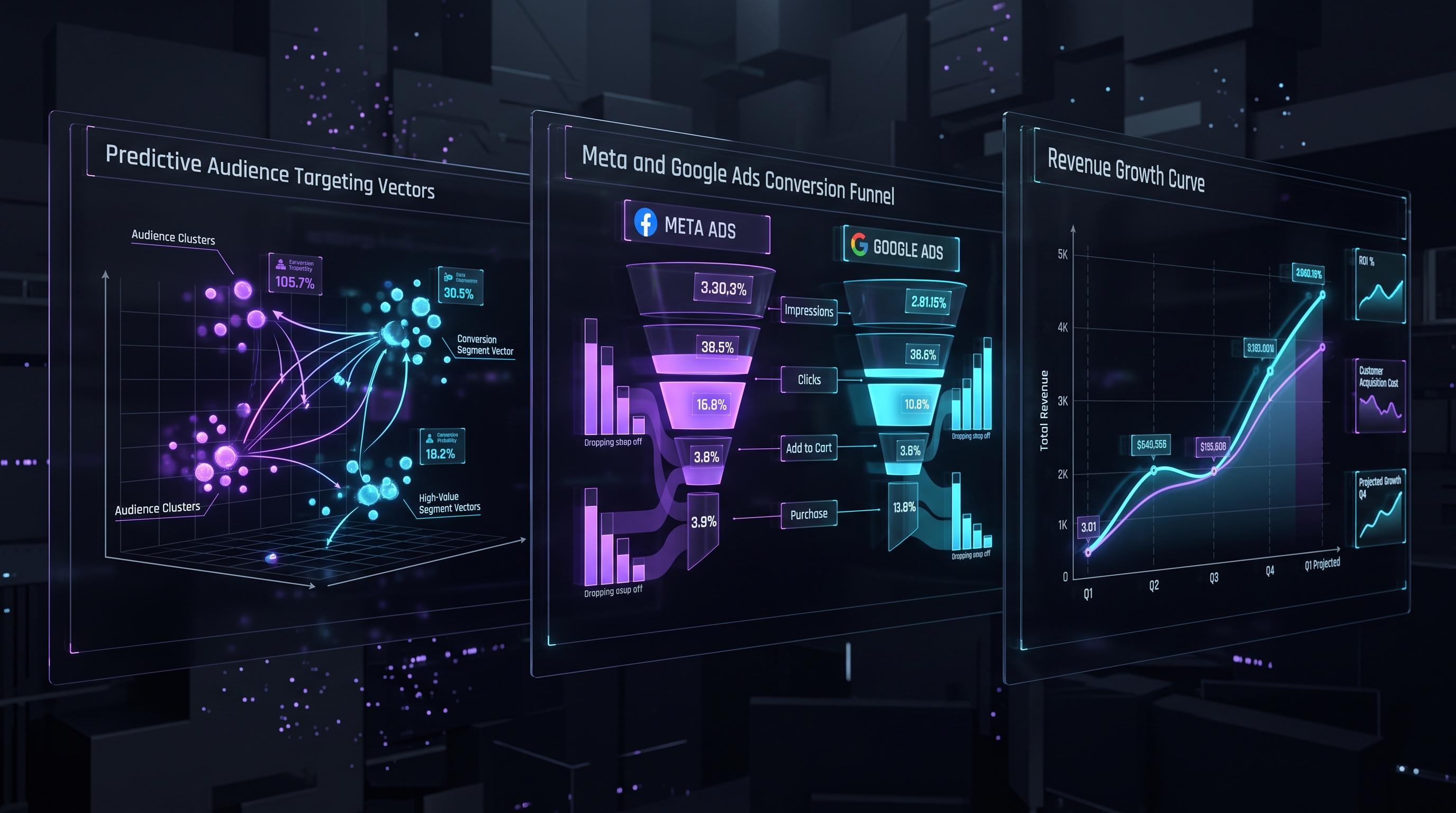
Rather than relying solely on platform-level broad interest tags, enterprise scaling starts with high-intent first-party data. By feeding Customer Lifetime Value (LTV) vectors back into Meta Conversions API (CAPI) and Google Enhanced Conversions, ad algorithms optimize for high-margin buyers rather than cheap, low-intent clicks.
Predictive segmentation groups audiences into behavioral affinity buckets, ensuring cold prospects receive high-trust positioning while warm leads see targeted urgency triggers.
Pillar 2: Programmatic Retargeting & Creative Fatigue Mitigation
Ad fatigue is the silent killer of ROAS. When Frequency metrics rise above 3.5 without creative variation, Click-Through Rates (CTR) drop and Cost Per Mille (CPM) rates surge. To prevent creative exhaustion, we implement modular creative frameworks where hooks, visual angles, and offers cycle automatically based on performance triggers.
Pillar 3: Post-Click Conversion Rate Optimization (CRO)
Ad performance does not stop at the click. Driving hyper-targeted traffic to a generic landing page destroys acquisition efficiency. Aligning ad creative copy with dedicated, fast-loading post-click landing environments doubles conversion rates, effectively cutting acquisition cost in half.
4-Step Framework to Scale Your Ad Budget Profitably
- Server-Side Conversion Tracking: Deploy Meta CAPI and Google Ads Offline Conversion Tracking (OCT) to bypass browser privacy restrictions.
- LTV Audience Seeding: Import top 20% high-value customer segments to build precision lookalike audiences.
- Modular Creative Testing: Rotate 4 distinct video hooks and 3 visual formats weekly to eliminate creative fatigue.
- Bid Strategy Alignment: Transition campaigns to Target ROAS (tROAS) and Cost Cap bidding once baseline conversion volume stabilizes.
Conclusion: Sustainable Growth Through Engineered Paid Media
Scaling paid media spend does not have to mean sacrificing profit margins. By integrating predictive targeting, server-side attribution, and continuous creative optimization, your brand can confidently scale monthly ad budgets while keeping CAC firmly under control.